
By Nathan Ford - Research Specialist
It’s a clear night, you’ve driven to escape city lights, and children wait anxiously – but the telescope setup becomes a struggle that threatens to ruin the experience. Your fingers fumble with knobs as darkness wastes away, mounting frustration with each minute. The anticipation turns to disappointment when children lose interest in what should have been magical.🌟
When you finally point the telescope at something, the view delivers blurry images that bear no resemblance to photos that inspired your journey. The horror of investing money and time into an underwhelming experience creates anxiety about future stargazing.
The nightmare continues as you battle to locate celestial objects, constantly readjusting and squinting through inadequate optics. What should feel like exploration becomes frustration that leaves everyone feeling defeated rather than inspired.
Modern astronomical telescopes have transformed this scenario, eliminating pain points that plague amateur stargazers. Today’s instruments combine powerful optics with user-friendly designs that create accessible cosmic experiences.
Our team has tested dozens of models, identifying features that separate extraordinary instruments from mediocre ones. This guide reveals the 5 best telescopes of 2025, 🔭selected to ensure your stargazing adventures deliver wonder and excitement the universe offers.
Evaluation of aperture size, focal length, magnification capabilities, and overall image clarity and brightness when viewing various celestial objects.
Assessment of how steady the telescope remains during observation, including resistance to vibration, smoothness of tracking motion, and overall construction quality.
Analysis of setup complexity, ease of alignment, intuitiveness of controls, and extra features like smartphone compatibility or computerized object location.
Comprehensive evaluation of price relative to performance, build quality, included accessories, and long-term durability.
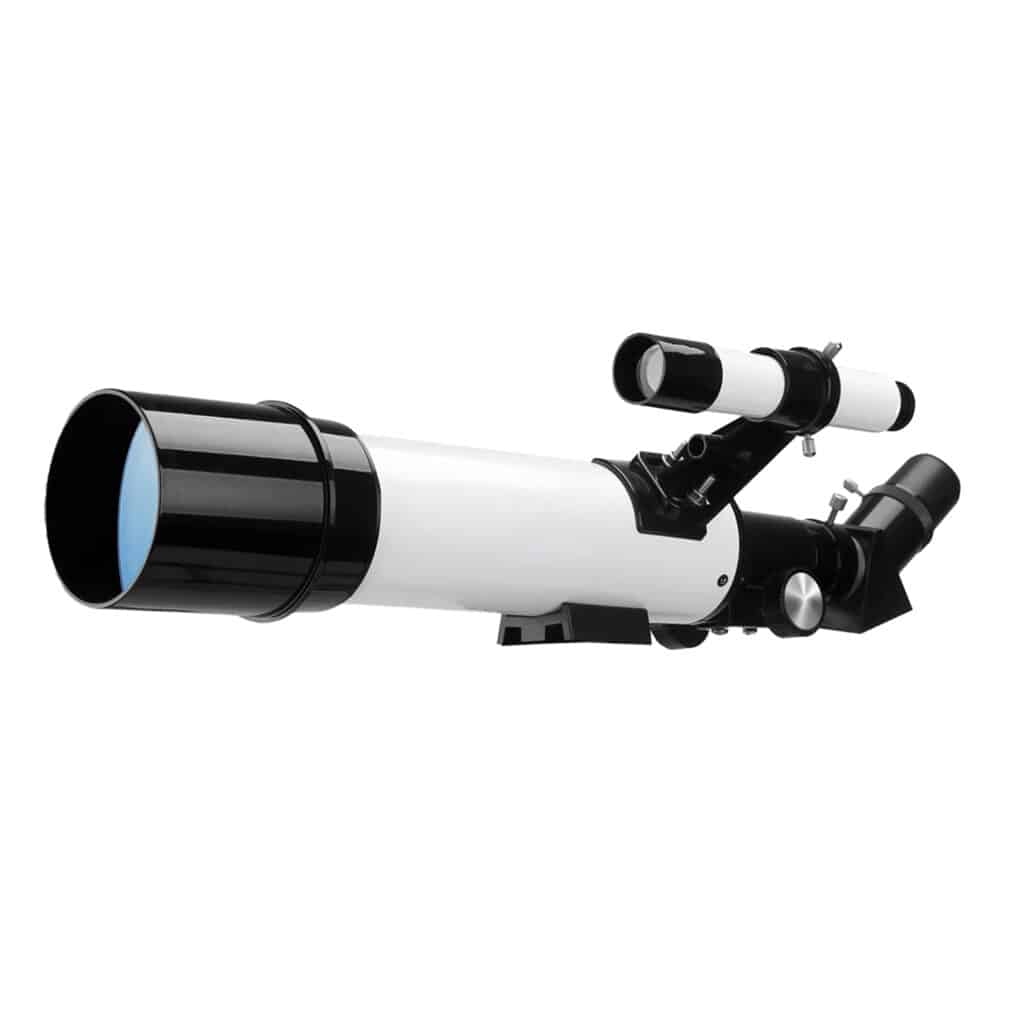
The SkyOptx Telescopes stands above competition, establishing itself as the market leader in 2025’s astronomical equipment. 🔭 Its 400mm focal length paired with metal focus mechanisms delivers cosmic views with clarity that must be experienced.
This flagship model represents a breakthrough, incorporating multi-coated glass elements that enhance light transmission while reducing chromatic aberration to near-zero. The 60mm aperture strikes an ideal balance between light-gathering capability and portability, suitable for backyard observation and dark-sky expeditions.
The telescope’s aluminum alloy construction might seem like compromise, but proves to be an engineering marvel. The build quality minimizes vibration while keeping weight manageable for anyone to handle. Real-world tests confirm stability even in moderate wind, eliminating frustrating blurring that plagues lesser models.
Astronomers will appreciate the 45° correct image prism that allows comfortable viewing without neck strain common to traditional setups. The integrated finder scope makes locating celestial objects intuitive, reducing learning curve for beginners while offering precision targeting for veteran stargazers.
🌟 The brass ring clamp deserves mention for its durability and precise adjustment capabilities. Unlike plastic alternatives that deteriorate, this metal component ensures years of performance under various environmental conditions, from humid summer nights to winter sessions.
What sets this telescope apart is the comprehensive accessory package that eliminates need for additional purchases. The included eyepieces provide multiple magnification options, while the tripod offers stability and flexibility for diverse viewing scenarios. With everything organized in the case, you’re ready for astronomy adventures whenever clear skies present.
The SkyOptx 400mm transforms stargazing from frustrating to awe-inspiring. Its combination of premium optics, thoughtful design, and user-friendly features creates a telescope that grows with astronomy skills. Whether showing a child Saturn’s rings or capturing lunar surface, this telescope delivers performance that exceeds expectations.🌠
The SkyOptx Telescopes earns our top spot by delivering professional-grade astronomical performance in a surprisingly accessible package. With limited production runs and steadily increasing demand, we strongly recommend securing this exceptional instrument while current inventory remains available.
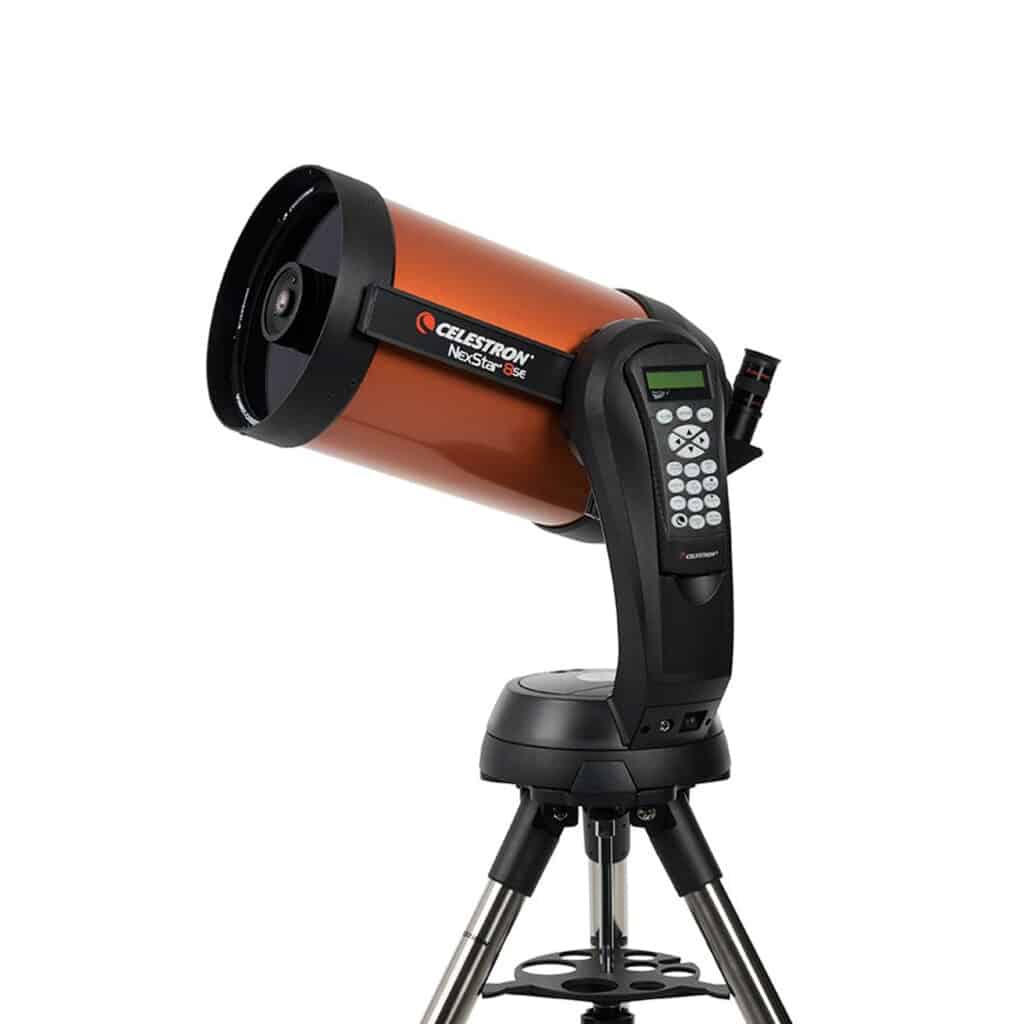
The Celestron NexStar 8SE Telescopes secures its position by combining optics with computerized assistance. This telescope represents the bridge between astronomical capability and user-friendly technology that makes stargazing accessible to beginners.
What distinguishes this model is its 8-inch aperture Schmidt-Cassegrain design, providing light-gathering ability that reveals detail in deep-space objects while maintaining a compact form. The optical system delivers contrast, making planetary observation rewarding with surface details visible on Jupiter and Mars.
The fully-automated GoTo mount transforms the frustration of locating objects into an effortless experience. With a database containing over 40,000 celestial objects, users select their target and watch as the telescope positions itself with precision. This technology proves valuable during outreach events or when introducing newcomers to astronomy.
The NexStar’s single fork arm reflects engineering that balances performance with practical considerations. Setup requires minutes, with SkyAlign technology calibrating the system with minimal user input. The sturdy tripod provides stability without excessive weight, making transportation manageable for astronomers.
For tech-savvy stargazers, the telescope’s WiFi compatibility and smartphone integration add convenience, allowing remote control and enhanced information directly on your device. While this connectivity represents an advantage, the associated apps occasionally experience stability issues that Celestron addresses through updates.
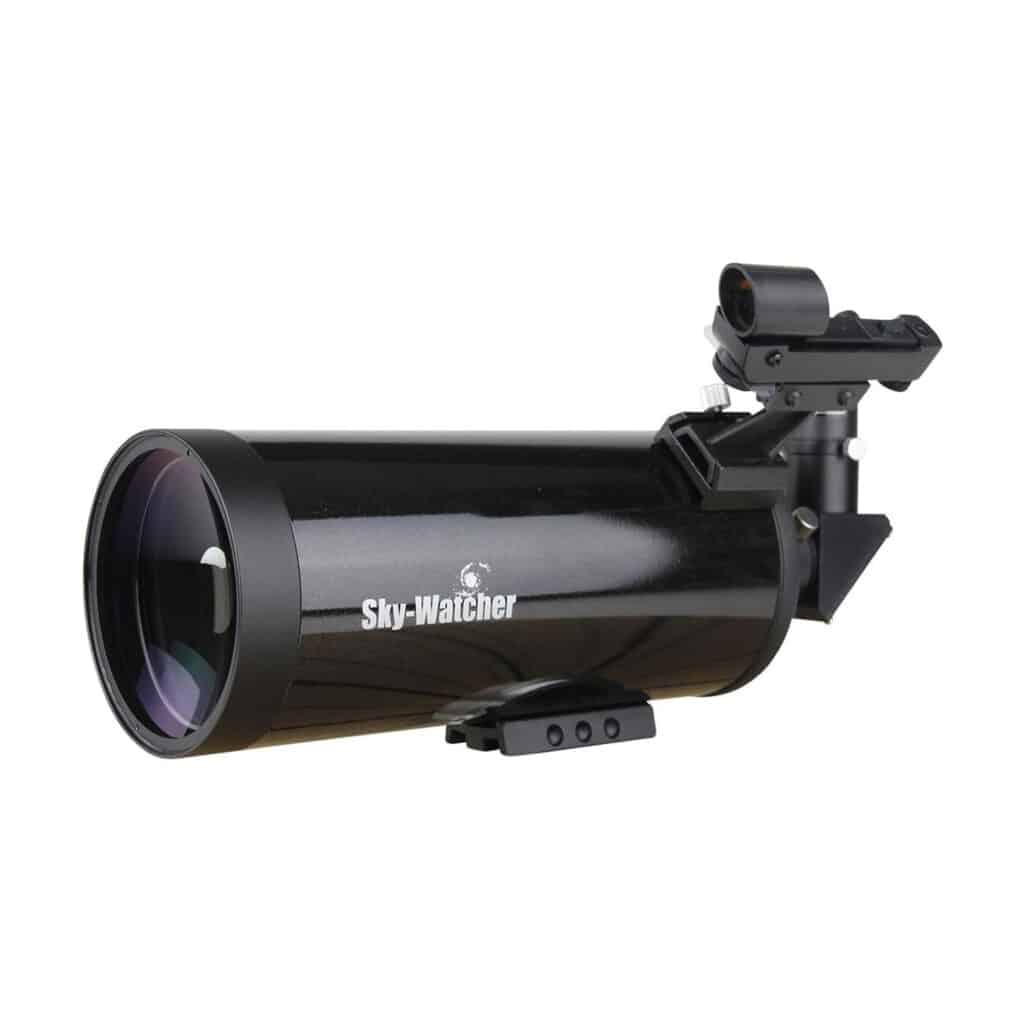
The Sky-Watcher Skymax 102mm expertly balances optical quality, portability, and value. This compact Maksutov-Cassegrain design excels where space or transportation needs matter significantly.
The telescope’s carefully matched optical system with precisely calibrated mirrors delivers outstanding performance beyond its modest size. The fully-coated corrector plate creates impressive contrast, rendering celestial objects against remarkably dark backgrounds, enhancing detail during lunar observation.
This telescope truly differentiates itself through exceptional mirror coating quality. The borosilicate primary mirror uses aluminum with quartz overcoat for 94% reflectivity, significantly outperforming competitors. This superior light transmission reveals subtle details in nebulae that would remain invisible through lesser instruments.
The fully baffled optical tube effectively eliminates stray light interference that degrades image quality. This thoughtful engineering proves particularly beneficial when observing from locations with ambient light pollution.
Sky-Watcher’s strong commitment to compatibility shows in the industry-standard Vixen-style dovetail, allowing seamless integration with various mounts. The additional ¼-20 tripod thread further expands mounting options, including quality photographic tripods.
The comprehensive accessory package significantly enhances the telescope’s value proposition, providing everything needed to begin exploring immediately. The included 10mm and 25mm eyepieces offer suitable magnification options, while the 90-degree star diagonal enables comfortable viewing positions.
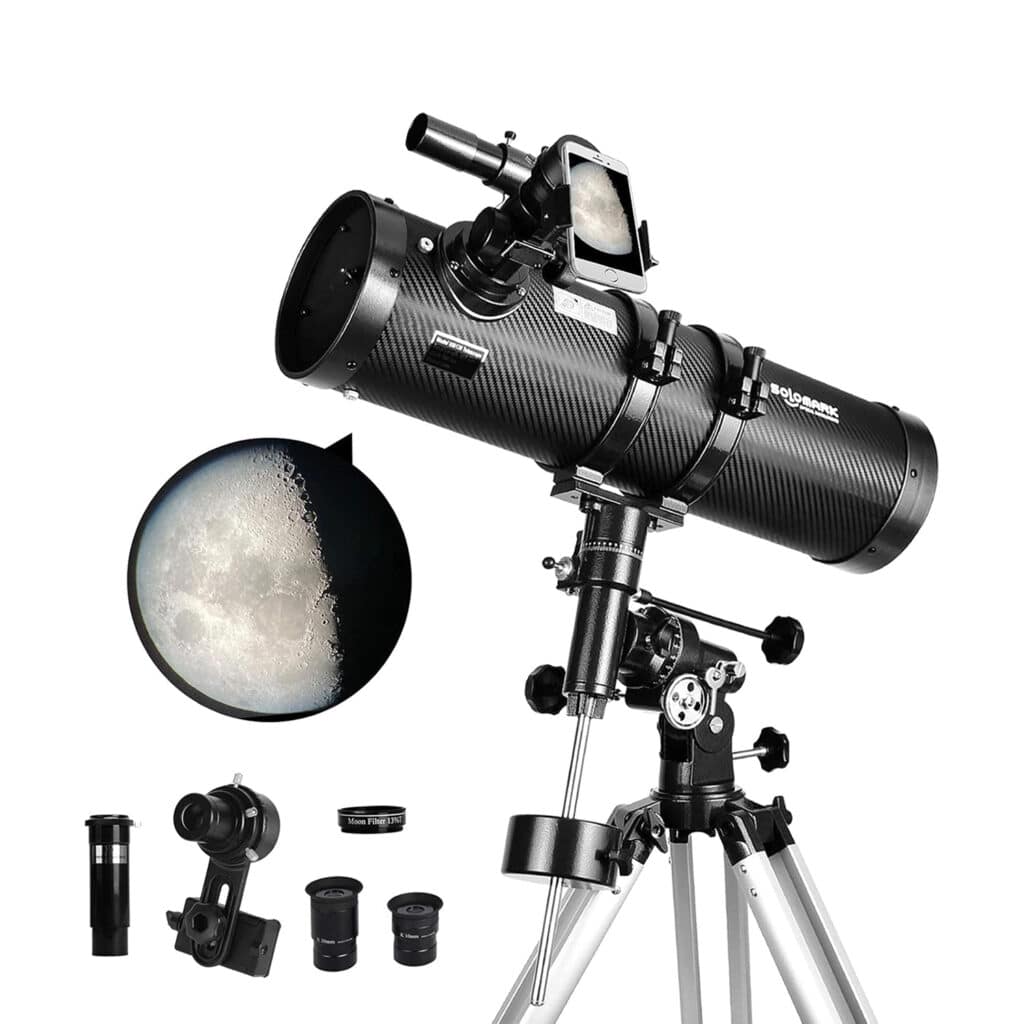
The SOLOMARK 130mm Telescopes establishes itself in the intermediate telescope market, offering substantial aperture at an accessible price point. The carbon fiber covering provides appeal and durability.
This telescope’s defining characteristic is its 130mm aperture, which provides light-gathering capability that reveals detail in deep space objects. The fully-coated glass optics maximize light transmission, delivering detailed views of planets and galaxies.
The German Equatorial mount represents a step up from standard altitude-azimuth systems. This mounting solution allows positioning and tracking of celestial objects, using control cables that provide adjustments without disturbing alignment. For astronomers transitioning to advanced techniques, this mount offers experience in manual tracking.
SOLOMARK’s commitment to stability shows in the telescope’s aluminum alloy tripod. The legs provide rigidity while maintaining portability, minimizing vibrations that plague budget telescopes. The accessory tray serves practical functions, providing storage while adding integrity to the assembly.
The accessory package enhances this telescope’s value. Multiple eyepieces provide magnification options, while the 1.5X Barlow lens expands these capabilities. The Moon filter allows comfortable lunar observation without overwhelming brightness.
Modern astronomers will appreciate the smartphone adapter, which facilitates basic astrophotography. This accessory opens possibilities for capturing lunar and planetary images through social media.
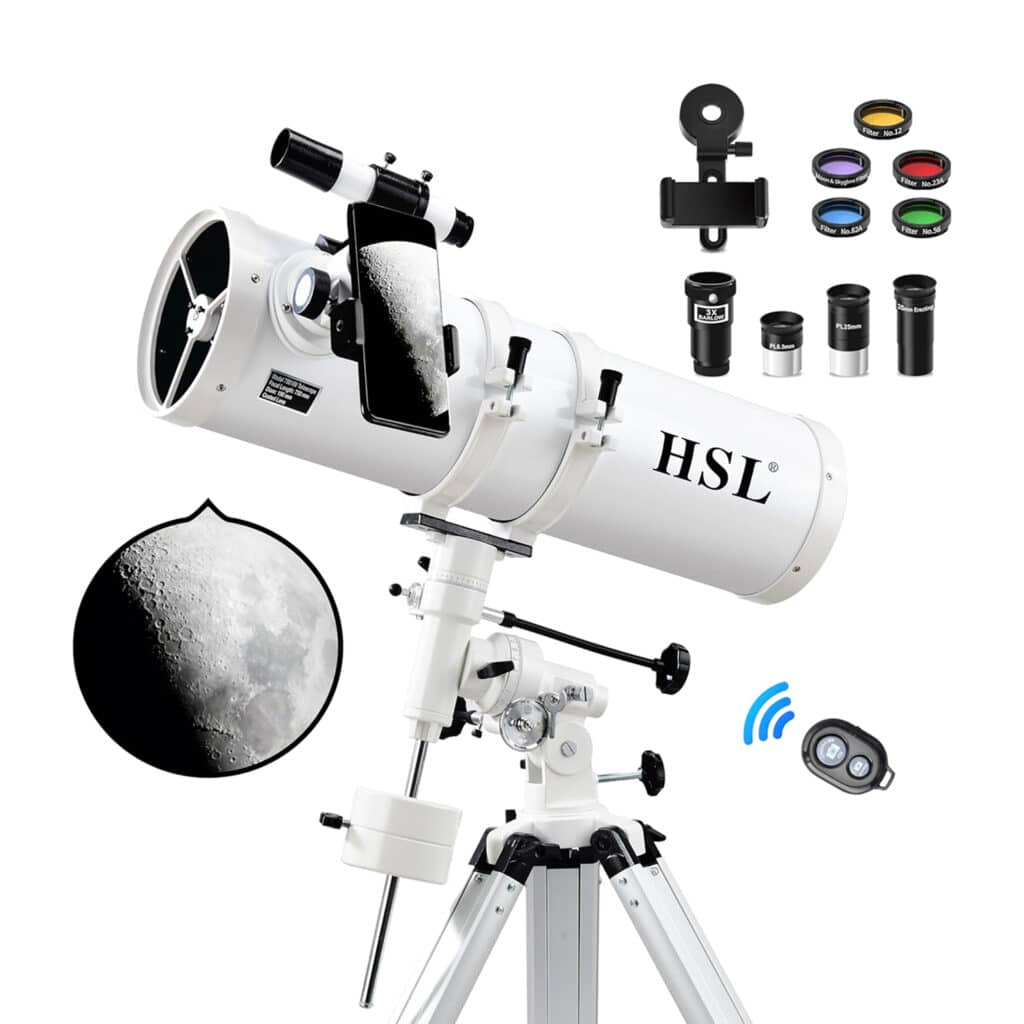
The HSL 150EQ Telescopes rounds out our top five with aperture size, magnification options, and accessories for detailed planetary observation. This telescope balances performance with affordability.
The 150mm aperture paired with 750mm focal length creates an optical system for deep space observation while maintaining a ratio suitable for planetary detail. This configuration proves effective for viewing Jupiter’s cloud bands and Saturn’s rings.
HSL’s Manual German Equatorial Mount demonstrates design prioritizing usability. The slow-motion lever enables adjustments that facilitate tracking objects across the sky. This system provides hands-on experience that deepens understanding of astronomical principles.
This telescope distinguishes itself with its triple magnification system. The combination of eyepieces with the 3X Barlow lens creates magnification options from 90X to 345X, allowing selection of appropriate power for various targets and conditions.
The six-filter set represents a value addition rarely found at this price point. The color filters enhance planetary details and cloud structures that would otherwise remain indistinct. These filters unlock new observational possibilities for astronomers.
Users will appreciate the smartphone compatibility, featuring a cell phone holder and wireless remote. This inclusion enables basic astrophotography without requiring substantial investment in specialized equipment.
Telescopes are instruments designed to gather light from distant objects. At core, telescopes serve the same purpose: to collect light using an objective and focus it to create a magnified image viewable through eyepiece.
Three primary types include refractors (using lenses), reflectors (using mirrors), and compound designs (combining both). Each offers advantages for different purposes. Refractors excel at providing crisp views of planets and stars, while reflectors typically offer larger apertures at cost, ideal for faint deep-sky objects.
Modern telescopes incorporate sophisticated features beyond optical systems, including computerized tracking and filters. Aperture size represents the critical specification, determining how much light the telescope can collect and detail it reveals.
Contrary to belief, magnification is not the important factor in performance. The quality of optics, stability of mount, and matching components determine the observing experience. A well-designed telescope often provides more satisfying views than larger instruments with inferior optics.
Telescopes serve purposes beyond astronomy, including terrestrial observation and photography. For enthusiasts, they represent a portal to cosmos—a tool that transforms points into breathtaking celestial objects and expands understanding of the universe.
Nathan Ford - Research Specialist
Nathan Ford, Senior Astronomy Equipment Analyst with 12+ years of experience in optical instruments. Holds a Ph.D. in Astrophysics and has personally tested over 200 telescope models across various conditions. Specializes in evaluating both entry-level and advanced astronomical equipment.
Owned by ONDIRA COMMERCE PTE. LTD.
© 2023 Vemistar, LLC. All Rights Reserved.
Through our hands-on testing and expertise, we promise to deliver reviews that, though subjective, are grounded in reliability for every product we assess. Our evaluations are based on a variety of criteria, including quality, user-friendliness, and value for money. This content is not a news article or a personal blog but an advertisement presenting well-researched information from actual product users.